Q2 2026: Momentum Markets Driven By Hopes of a Cease-fire, AI Exuberance
So far this year the equity markets have followed last year’s pattern: a difficult start followed by a strong rebound. Last year’s early sell-off was driven by the “Liberation Day” tariff announcements. This year, the attack on Iran and AI-related fears in the software sector drove markets down in the first quarter, but news of a potential cease-fire and excitement over mega-cap technology IPOs (initial public offerings) drove a massive recovery in the second quarter. Corporate earnings remain the market’s real anchor, with ~24% growth expected for Q2 and full year, according to Factset Insight[1].
Q2 2026: Key Points
- Best quarter for S&P 500 Index since 2020, equity markets hit record levels
- Iran war cease-fire fueled optimism that oil prices would drop and inflationary pressures would ease
- AI exuberance and Iran War cease-fire are driving a “momentum” market. Momentum markets are characterized by trend-following and positive investor psychology, and can be subject to rapid declines
- Federal Reserve interest rate cuts, hoped for at the start of the year, are likely off the table. Now market expectations are for 1-2 rate hikes as we move through 2026
First Half of 2026: Market Performance
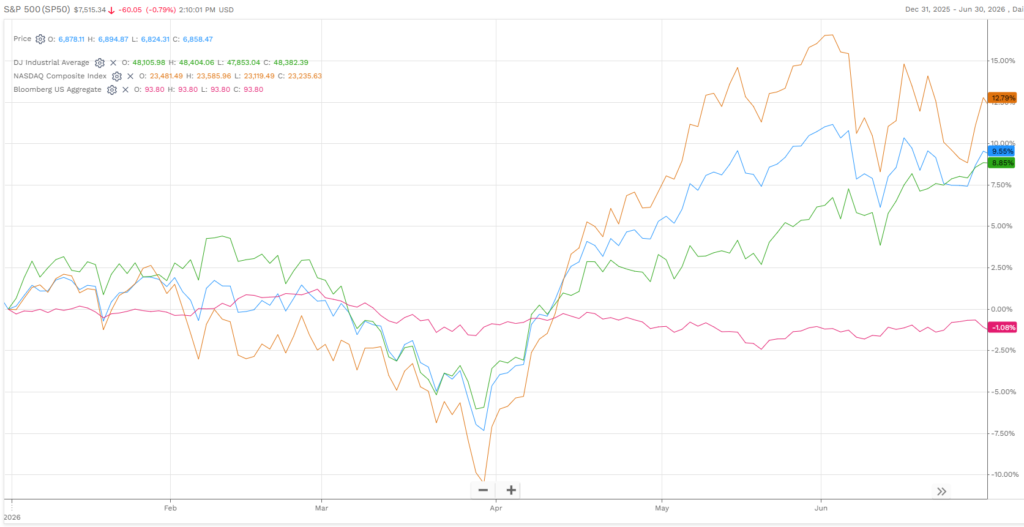
After market declines in first quarter of 2026, the second quarter saw a dramatic rebound. During the quarter, the S&P Index rallied 14%, the tech-heavy NASDAQ Index was up 22%, and the stodgier DJIA Index up over 12%. The Bloomberg Aggregate, a key benchmark for the fixed income markets, was stable this quarter. For the first half of 2026, the S&P Index is up ~10%, the NASDAQ is up nearly 13%, the DJIA Index is up nearly 9% and the Bloomberg Aggregate is down ~1%.
Iran Cease-Fire – A Moving Target
A cease-fire in Iran and a peace settlement favorable to the US is the optimal outcome in the Iran conflict. It appears that a cease-fire may be in the cards, which overall is favorable for financial markets as it lessens the upward pressure on oil prices and subsequently, inflation. This in turn means that it is less urgent for the Federal Reserve to raise rates, which it would do to dampen inflationary pressures. Note that a cease-fire may not be the best long-term geopolitical outcome. Should Iran’s takeaway be that the Strait of Hormuz can be used as an easy lever in the future, it will use it and create additional future volatility around oil prices.
AI and Market Exuberance – Will It Be Justified?
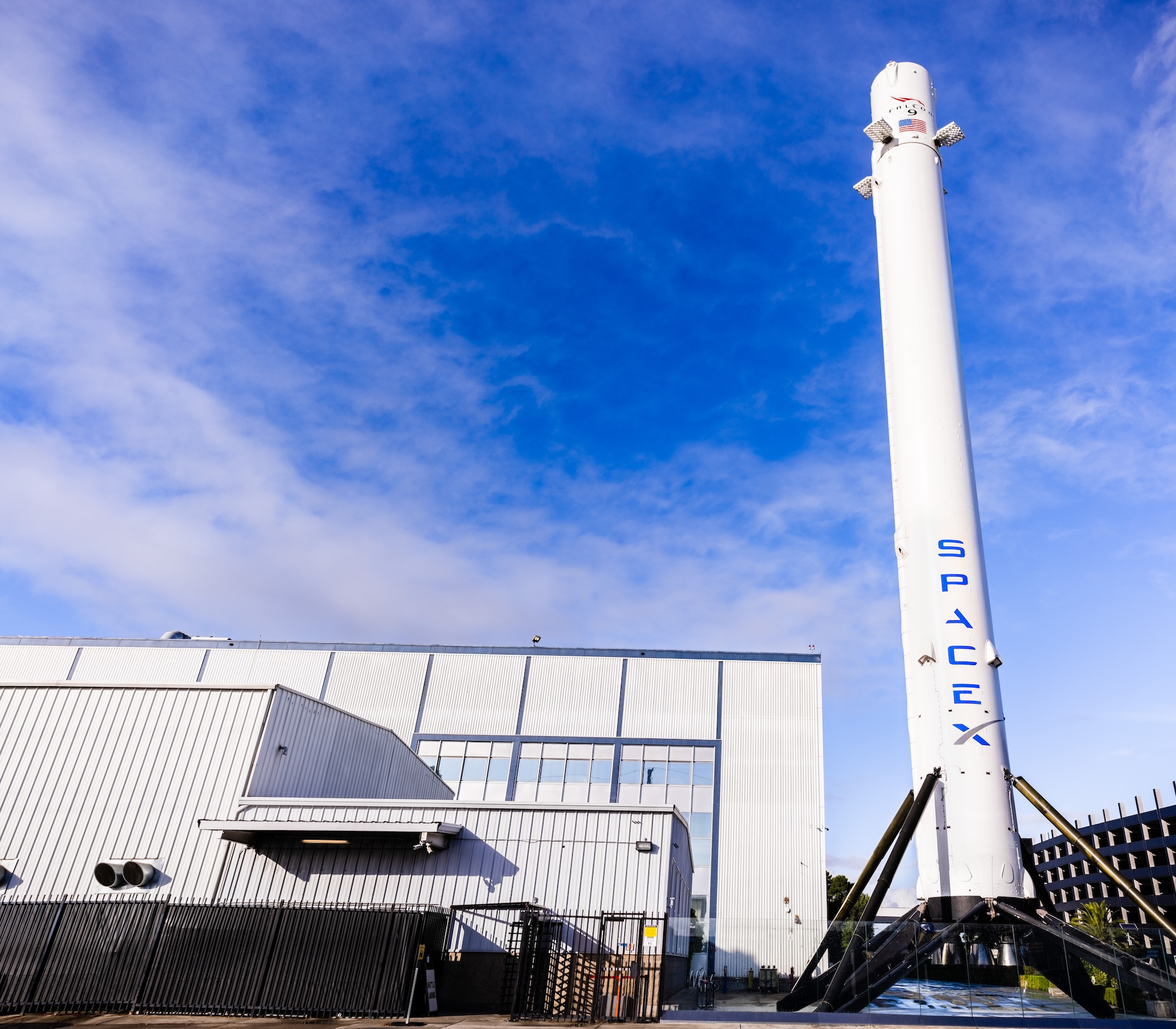
AI continues to create significant market volatility. Earlier this year, companies who were perceived to be vulnerable to AI disruption, including many software companies, saw abrupt and significant declines. In the second quarter, Wall Street began the ‘hype cycle’ for large AI initial public offerings. SpaceX, primarily an AI company, was first out of the gate with an initial public offering in June. OpenAI and Anthropic, major mega-cap AI companies, are expected to IPO in the fall. At the same time, shortages of the “compute” products required for AI, including semiconductors and memory, caused price spikes in the stocks and an investor frenzy. Currently, the market appears to be ignoring whether AI companies will ultimately make money and what that return on investment looks like. Should reality not match expectations, markets will correct.
Detail on the Quarter: Inflation and The Federal Reserve – What is the Path of Interest Rates?
“Whipsaw” is the theme for the year both for AI and in terms of interest rate expectations. While hopes at the beginning of the year were for rate cuts, the attack on Iran shifted sentiment. Now, uncertainty around interest rates has increased. Current expectations are for 1-2 rate hikes for the rest of the year, and ending the year at ~4% . Kevin Warsh, the new Chairman of the Federal Reserve, has been a “hawk” historically, meaning his tendency has been to raise rates to make sure inflation did not get out of control. Higher rates are intended to control inflation, and typically slow the economy and financial markets.
2026 Outlook: Downside Risks Heightened, Positives Remain
In this momentum market, risk/reward feels asymmetric to the downside, meaning that it may be that stocks have more potential to go down versus up. To paraphrase Chuck Prince, Citi’s CEO leading into the financial crisis, is the market just dancing until the music stops?
The key items to watch as we move through the rest of this year include:
- The magnitude and duration of the Iran war, which will affect oil prices, inflation and the federal budget deficit
- Inflation and labor market data and the future path of Fed interest rates and monetary policy, which are currently highly dependent on oil prices
- AI-driven “FOMO” (fear of missing out): The SpaceX IPO and the stampede into AI companies has created what is potentially unsupported optimism around these companies. There is significant “FOMO”, particularly as Elon Musk became the world’s first trillionaire and the SpaceX IPO created many new billionaires. . This type of market sentiment makes sudden declines more likely when there is disappointing news.
- Market concentration risk: The top 10 megacap tech / AI companies make up nearly 40% of the S&P 500 Index. This index is broadly held here in the US and globally, and makes up a significant amount of 401(k)s and other retirement accounts. Should these top companies falter, the markets could face declines.
- Political noise will increase further as we approach mid-term elections.
- Watch corporate earnings – still the market’s key support
Risk Management
Lariat Wealth Management focuses on growing wealth while managing risk. Investing in quality companies with attractive revenue growth, improving profitability and strong free cash flow remains core to our investment philosophy. Risk is often ignored when the market is simply going up. However, risk management, through quality holdings and portfolio diversification, remains the key the successful long-term investing.
[1] Factset Insight, July 10, 2026, John Butters.
This material has been prepared for informational purposes only. All opinions and estimates constitute the firm’s judgment as of the date of this publication and are subject to change without notice. This material is not intended to provide, and should not be relied on for tax, legal or accounting advice. It is not intended as an offer or solicitation with respect to the purchase or sale of any security. Investing may involve risk including loss of principal. Past performance is no guarantee of future results.